
The Host Ghost Activate Await Framework: How to Thrive in the First 90 Days of a New Job
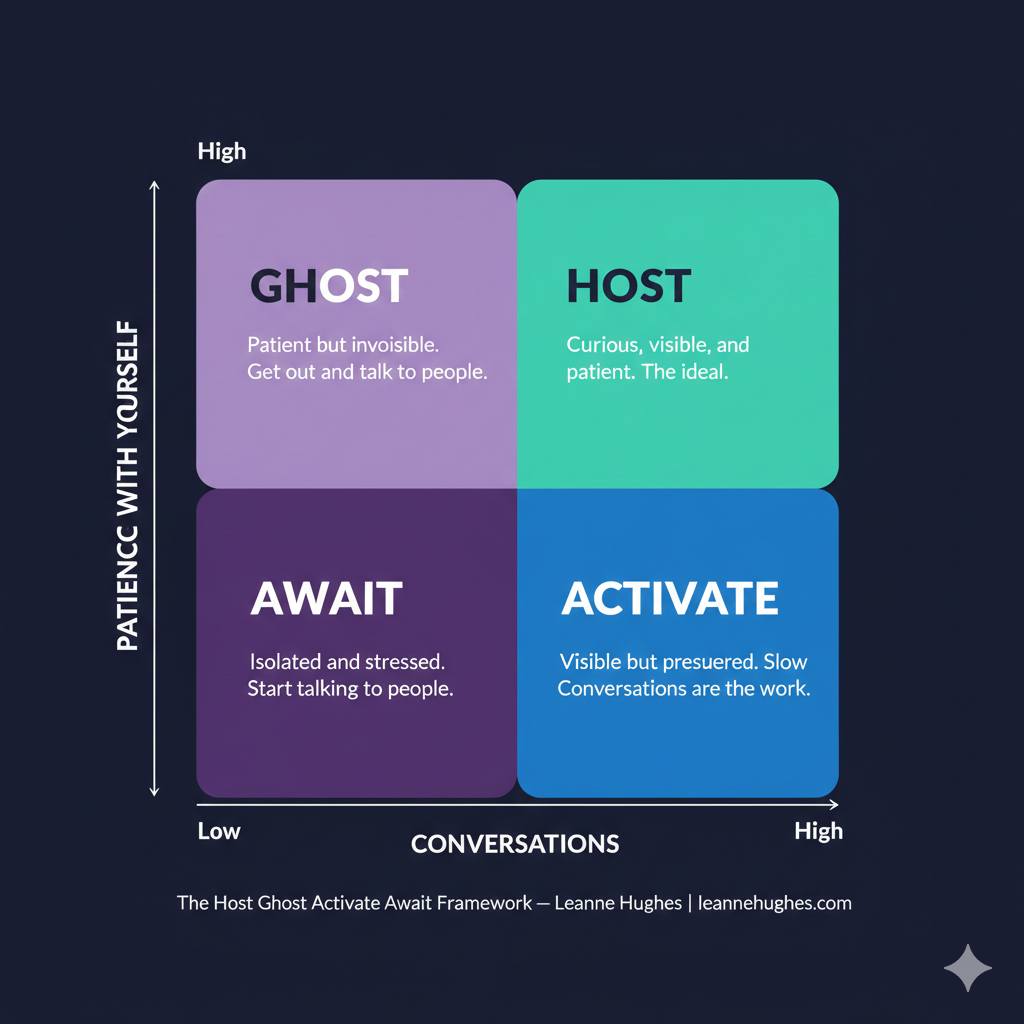
The Host Ghost Activate Await Framework is a two-by-two matrix that helps people navigate the first 90 days of a new job. Created by Leanne Hughes, it maps two variables: Conversations (how frequently you are talking to people) and Patience (how much pressure you are putting on yourself to deliver results quickly). The four quadrants are: Host (high conversations, high patience), Ghost (low conversations, high patience), Activate (high conversations, low patience), and Await (low conversations, low patience). The ideal approach is to play the role of Host.
What is the Host Ghost Activate Await Framework?
Starting a new job comes with pressure to prove yourself, learn fast, and deliver quick wins. But the people who thrive in those first 90 days are not always the ones racing to make an impact. They are the ones having the most conversations while giving themselves time to listen, learn, and understand how things really work.
The framework maps two axes:
X axis: Conversations. How frequently are you getting out and talking to people? This includes face-to-face conversations, virtual calls, phone check-ins, and asynchronous communication. It ranges from low (keeping to yourself) to high (actively connecting with people across the organisation).
Y axis: Patience with yourself. How much pressure are you putting on yourself to deliver results, understand everything, and prove your value immediately? High patience means giving yourself grace to learn. Low patience means pushing yourself hard to perform from day one.
The framework applies to anyone starting in a standard role. It is not designed for situations where someone has been brought in specifically to disrupt or make rapid changes.
The Four Quadrants
Host (High Conversations + High Patience)
Top right quadrant. You are having lots of conversations and you are being patient with yourself. This is the ideal quadrant for your first 90 days.
Playing the role of Host means you are curious, open-minded, and actively connecting with people, but you are not pressuring yourself to have all the answers or deliver results immediately. You add value by listening, asking questions, and learning how things really work before jumping to solutions.
Why Host works:
Jonah Berger's research in Invisible Influence shows that the frequency of interaction directly builds relationships. The more often people see you and talk to you, the more connected they feel to you. In your first 90 days, those conversations are building your reputation and your understanding of the business simultaneously.
You can ask any question in your first three months. That window is a gift. Use it. As Michael Bungay Stanier writes in The Advice Trap, you can add enormous value simply by being someone who listens and asks good questions rather than jumping straight into solution mode.
Being a Host means recognising that the conversations themselves are the work. They are not a distraction from getting things done. They are how you build relationships, learn the real dynamics of the organisation, and set yourself up to make a genuine contribution when the time is right.
Ghost (Low Conversations + High Patience)
Top left quadrant. You are being patient with yourself, but you are not getting out and talking to people. You are working behind the scenes, trying to understand the business before you engage.
The Ghost quadrant is common when you join an organisation with a steep learning curve, when there is a lot of information to absorb, or when formal onboarding keeps you buried in policies and systems. You feel like you need to understand the business before you are qualified to have conversations.
The problem with Ghost:
People want to know who you are. When a new person starts and is not visible, the perception is: where are they? What are they doing? If you promised to introduce yourself and did not follow through, trust erodes quickly.
The formal onboarding process, the policies, the systems training, is never enough on its own to get you up to speed. The informal knowledge lives in conversations. The way things actually get done, the unwritten rules, the relationships that matter, all of this comes from talking to people.
What to do if you are in Ghost: Give yourself permission to talk to people before you feel ready. You do not need to master the business before having a conversation. The conversations will teach you more than the induction materials ever will. Move along the Conversations axis toward Host.
Activate (High Conversations + Low Patience)
Bottom right quadrant. You are having lots of conversations, but you are also putting enormous pressure on yourself to deliver, understand everything, and prove your value fast.
This is the high-energy, high-pressure quadrant. You are keen, engaged, and talking to everyone, but internally you are racing. You want to learn all the acronyms, understand every policy, and produce quick wins immediately.
The problem with Activate:
The pressure is unnecessary and it does not serve you. Three months is not a long time. You have more runway than you think. The urgency you feel to perform can actually undermine the quality of the conversations you are having, because you are listening with an agenda rather than genuine curiosity.
What to do if you are in Activate: Keep having the conversations. That part is working. But give yourself permission to slow down. Recognise that the conversations themselves are a form of progress. You are building reputation, building relationships, and building understanding. That is getting things done, even if it does not feel like a deliverable.
The shift from Activate to Host is not about doing less. It is about releasing the internal pressure and trusting that the value you are building through conversations will compound over time.
Await (Low Conversations + Low Patience)
Bottom left quadrant. You are not having conversations and you are putting pressure on yourself to perform. You are isolated and stressed.
Await happens when you feel like you need to learn everything before engaging, combined with impatience about how long that learning is taking. You might be buried in reading, studying the business, trying to absorb information alone, and feeling frustrated that you are not up to speed yet.
The problem with Await:
You are trying to do alone what can only be done through people. The knowledge you need is not in the policy documents. It is in conversations. And the permission you are waiting for, to feel ready, to feel qualified, to feel like you belong, does not come from more reading. It comes from showing up.
What to do if you are in Await: Start talking to people. That is the single most important thing you can do. You do not need to know the business to have a conversation. People love being asked for their advice and their perspective. Every conversation will teach you something the induction materials cannot. Move along the Conversations axis first, then work on releasing the internal pressure.
How to Use the Framework
For yourself when starting a new role
Before your first week or at any point during your first 90 days, place yourself on the matrix. Ask: how many conversations am I having, and how much pressure am I putting on myself? If you are anywhere other than Host, the framework tells you exactly which axis to work on.
The direction of travel for every quadrant is the same: move toward Host. Increase conversations. Increase patience. The conversations are the work.
For leaders onboarding new team members
Use the framework to check in with new starters. Ask them: which quadrant do you think you are in? This opens an honest conversation about pacing, expectations, and the invisible pressure people put on themselves when starting a new role. It also gives you language to say: slow down, have more conversations, and give yourself time.
For HR and onboarding design
The framework highlights that formal onboarding (policies, systems, compliance training) pushes people toward Ghost or Await. It is necessary but insufficient. The informal side, conversations, relationships, curiosity, is what actually helps people thrive. Design onboarding experiences that deliberately create conversation opportunities, not just information downloads.
The Principle Behind the Framework
The Host Ghost Activate Await Framework is built on two insights. First, relationships are built through frequency of interaction, not a single impressive moment. The more conversations you have, the more people feel connected to you and the more you understand the organisation. Second, the pressure to prove yourself immediately is almost always self-imposed and counterproductive. Patience is not passivity. It is strategic.
The combination of high conversations and high patience creates the conditions for genuine thriving: you are visible, you are learning, you are building trust, and you are not burning yourself out in the process.
Frequently Asked Questions
What is the Host Ghost Activate Await Framework? The Host Ghost Activate Await Framework is a two-by-two matrix created by Leanne Hughes for navigating the first 90 days of a new job. It maps conversation frequency against patience with yourself. The four quadrants are: Host (high conversations, high patience, the ideal), Ghost (low conversations, high patience), Activate (high conversations, low patience), and Await (low conversations, low patience).
How do you thrive in the first 90 days of a new job? Play the role of Host. Have as many conversations as possible with people across the organisation, and be patient with yourself about delivering results. The conversations themselves are building your reputation, your understanding of the business, and your relationships. You do not need to prove your value immediately. Listening, asking questions, and being curious is how you build a strong foundation in a new role.
What should you do in your first 90 days at work? Focus on two things: increasing the frequency of your conversations and giving yourself patience to learn before you try to deliver. The Host Ghost Activate Await Framework shows that the people who thrive are not the ones racing to produce quick wins. They are the ones who show up, connect with people, ask questions, and give themselves time to understand how things really work.
How do you build relationships in a new job? Research from Jonah Berger's Invisible Influence shows that relationship-building is driven by frequency of interaction. The more often people see you and talk to you, the stronger the connection. In a new role, prioritise getting out and having conversations, even brief ones, over staying at your desk trying to learn everything from documents and systems.
What is the biggest mistake people make when starting a new job? Putting too much pressure on yourself to deliver results immediately. The Host Ghost Activate Await Framework calls this the Activate or Await trap. The urgency to prove yourself is almost always self-imposed. Giving yourself patience while staying visible through conversations is a more effective strategy for long-term success than racing to produce quick wins.
How do you avoid being a ghost in a new role? Get out and talk to people before you feel ready. You do not need to master the business before having a conversation. The informal knowledge you need, the unwritten rules, the real dynamics, lives in conversations, not in policy documents. Start with curiosity. Ask people about their role, their challenges, and their advice for someone new.
Who created the Host Ghost Activate Await Framework? The Host Ghost Activate Await Framework was created by Leanne Hughes, a Brisbane-based keynote speaker, workshop facilitator, and author of The 2-Hour Workshop Blueprint. The framework draws on research from Jonah Berger's Invisible Influence and Michael Bungay Stanier's The Advice Trap.