
The Craft and Content Framework: How to Build Awareness and Credibility
The Craft and Content Framework is a two-by-two matrix that helps professionals build awareness and credibility in their field. Created by Leanne Hughes, it maps two variables: Craft (how good you are at what you do) and Content (how consistently you share your thinking publicly). The four quadrants are: Prime Time (high craft, high content), Best Kept Secret (high craft, low content), Onto a Good Thing (low craft, high content), and Crossroads (low craft, low content). Each quadrant comes with a specific strategy for growth.
What is the Craft and Content Framework?
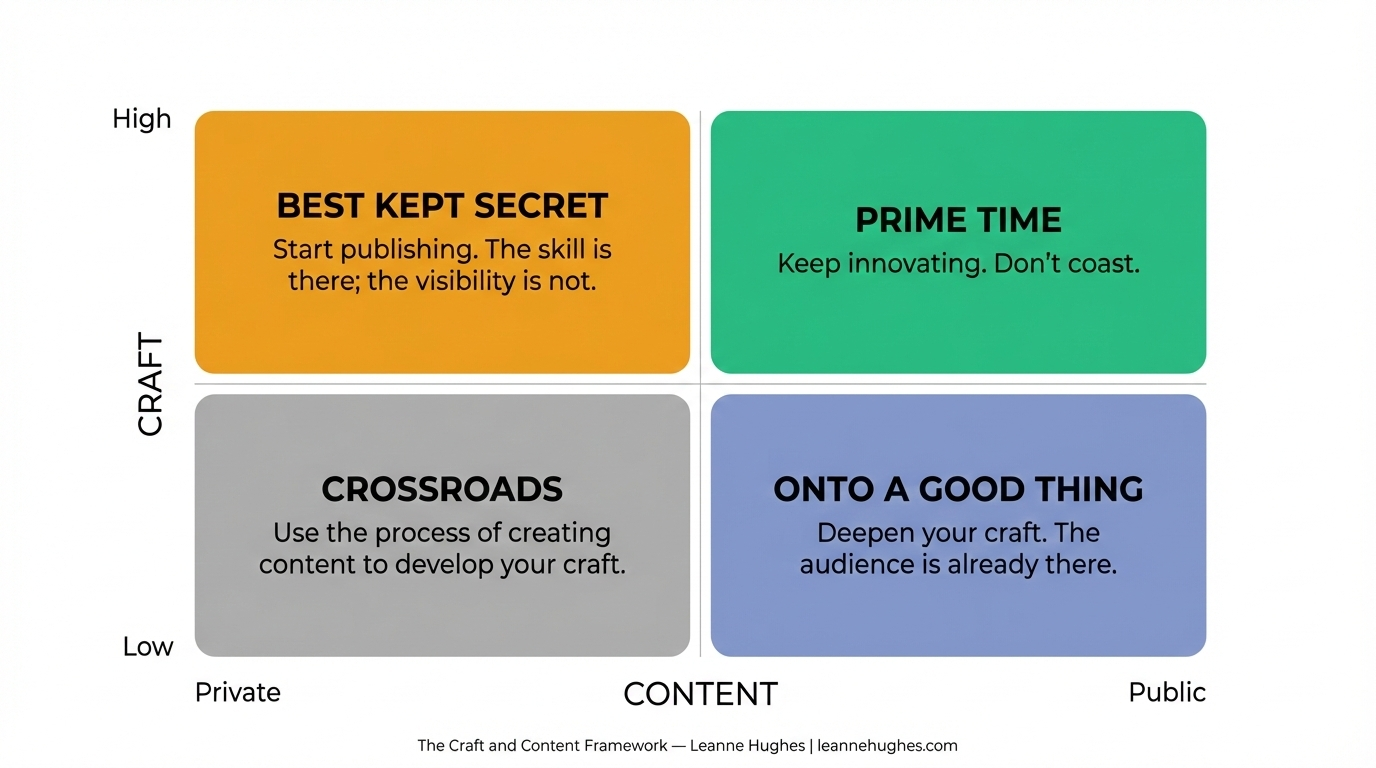
You can be brilliant at what you do, but if nobody knows about it, your opportunities are limited. Equally, you can have a large audience, but if there is no substance behind the content, it will not convert into lasting credibility. Building genuine awareness and credibility requires both dimensions working together.
The Craft and Content Framework maps two axes:
Y axis: Craft. How skilled are you at the thing you actually do? If you are a presentation skills trainer, how effective are you as a trainer? Do you get excellent results from clients? Do you have the presence and expertise to back up your positioning? This ranges from beginner (low craft) to exceptional (high craft).
X axis: Content. How consistently are you sharing your original thinking with the world? Are you writing articles, recording videos, publishing a newsletter, speaking publicly, or putting your ideas out in any format? This ranges from keeping your thoughts private (low content) to regularly publishing original thinking (high content).
The framework draws on two ideas. Alan Weiss uses the phrase "best kept secret" to describe experts who never publish. Jenny Blake talks about "public original thinking" as the practice of getting the ideas that live in your head out into the world. The Craft and Content Framework maps the relationship between these two dimensions and gives you a strategy for whichever quadrant you are in.
The Four Quadrants
Prime Time (High Craft + High Content)
Top right quadrant. You are exceptional at what you do, and you are consistently publishing and sharing your original thinking. This is where awareness and credibility compound. Your skill earns trust, and your content earns attention.
If you are in Prime Time:
Do not coast. This quadrant requires continuous innovation. Your favourite authors do not publish one book and stop. They continue creating, questioning, and refining. The world changes, your audience evolves, and your thinking needs to stay ahead.
The strategy here is to keep innovating. Challenge your own ideas. Update your frameworks. Bring out new content that builds on what came before. If you relax, you will drift into one of the other quadrants.
Best Kept Secret (High Craft + Low Content)
Top left quadrant. You are superb at what you do, but you are not sharing your thinking publicly. Your clients love you. People who work with you are blown away. But outside that small circle, nobody knows you exist.
This is one of the most common and most frustrating positions for consultants, facilitators, trainers, and subject matter experts. The craft is there. The credibility is there in the room. But the awareness is not, because the ideas stay private.
If you are a Best Kept Secret:
Start publishing. It does not need to be polished. Begin by sharing what you are already doing. What are you saying in client conversations that makes you effective? What insights come up in your workshops or coaching sessions? What questions do your clients keep asking you?
Work in public. Share behind-the-scenes thinking. Turn the advice you give privately into content you share publicly. The gap between Best Kept Secret and Prime Time is not about skill. It is about visibility. The content axis is the only thing standing between you and the top right quadrant.
Onto a Good Thing (Low Craft + High Content)
Bottom right quadrant. You are consistently getting your ideas out to the world and building an audience, but your craft may not yet match the attention you are attracting. There might be more sizzle than steak. You may be referencing other people's ideas more than creating original ones.
This quadrant gets a bad reputation, but it should not. If you are here, you have already done something most people never manage: you have built an audience and attracted attention. That is genuinely hard to do.
If you are Onto a Good Thing:
First, honestly assess your craft. Is it truly low, or is imposter syndrome talking? Seek evidence. Ask for feedback. Look at your results.
Then adopt a growth mindset. Be more intentional about improving your skills. Study the sources behind the ideas you share. Go deeper. Invest in learning from people who are exceptional at the craft. Use the audience you have already built as motivation to deliver more substance.
Continue creating content. Do not stop what is working. But layer in genuine skill development so the substance catches up with the visibility.
A note on imposter syndrome: The fear of being in this quadrant is what holds many people back from creating content at all. They worry that their ideas are not original enough or their craft is not strong enough. This fear creates a self-imposed ceiling that keeps talented people in the Crossroads or Best Kept Secret quadrants when they could be progressing toward Prime Time.
Crossroads (Low Craft + Low Content)
Bottom left quadrant. You are still developing your craft and you are not yet publishing content. You might be new to your field, or you might not have chosen a direction yet. This is a liminal space, an in-between stage where the path forward is not yet clear.
If you are at the Crossroads:
Use the process of creating content to improve your craft. This is the strategy Leanne Hughes used when she started The First Time Facilitator podcast. She rated herself low on facilitation craft and had no content out in the world. By interviewing experienced facilitators and publishing episodes every week, the content creation process itself became the vehicle for skill development. The podcast improved her craft, and the craft improved her content, creating a virtuous cycle.
You can do the same in any field. Start a newsletter where you document what you are learning. Begin a podcast where you interview people who are further ahead. Write about the problems you are solving as you encounter them. The act of publishing forces you to think more clearly, and the conversations you have along the way accelerate your development.
How to Use the Craft and Content Framework
As a self-assessment
Place yourself on the matrix honestly. Ask: how would I rate my craft compared to the best in my field? And how consistently am I sharing my original thinking publicly? The quadrant you land in tells you exactly which axis to focus on next.
As a growth strategy
Each quadrant has a clear direction of travel:
Prime Time: Keep innovating. Do not stop.
Best Kept Secret: Start publishing. The craft is there; the visibility is not.
Onto a Good Thing: Invest in deepening your craft. The audience is there; the substance needs to catch up.
Crossroads: Use the process of creating content to develop your craft simultaneously.
As a team or peer conversation
Use the matrix in a team workshop, mastermind group, or peer coaching session. Ask each person to place themselves on the matrix and share what they think their next move should be. This creates an honest conversation about development priorities and often reveals that the Best Kept Secret quadrant is far more crowded than people realise.
The Connection to the Booked Out Facilitator Model
The Craft and Content Framework is part of a broader model Leanne Hughes calls the Booked Out Facilitator, which includes three variables: Craft, Content, and Connection. Connection refers to the relationships you have and how you leverage your network. This framework focuses on the first two variables. When all three are working together, awareness and credibility compound into a sustainable, booked-out practice.
Frequently Asked Questions
What is the Craft and Content Framework? The Craft and Content Framework is a two-by-two matrix created by Leanne Hughes that maps professional skill level (craft) against content output to help people build awareness and credibility. The four quadrants are: Prime Time (high craft, high content), Best Kept Secret (high craft, low content), Onto a Good Thing (low craft, high content), and Crossroads (low craft, low content).
How do you build professional credibility? Building credibility requires both skill and visibility. The Craft and Content Framework shows that being excellent at what you do (craft) is not enough on its own. You also need to share your thinking publicly (content). The most credible professionals operate in the Prime Time quadrant, where high craft and consistent content reinforce each other.
How do you build awareness for your expertise? Start by assessing where you sit on the Craft and Content Framework. If your craft is strong but your visibility is low, you are a Best Kept Secret and the priority is to start publishing. If your content is strong but your craft needs development, invest in deepening your skills. The fastest path to awareness is sharing your original thinking consistently while continuing to improve at what you do.
What is the Best Kept Secret problem? The Best Kept Secret is the top left quadrant of the Craft and Content Framework. It describes professionals who are exceptional at their craft but do not share their thinking publicly. Their clients love them, but the wider market does not know they exist. The solution is to start creating content, even imperfectly, by sharing the insights they already deliver privately in client conversations, workshops, and coaching sessions.
How do you start creating content as an expert? Begin by sharing what you are already saying privately. If you give advice in client calls, workshops, or coaching sessions, that advice is content waiting to be published. Share behind-the-scenes thinking. Document your process. Turn frequently asked questions into articles or posts. The gap between private expertise and public content is smaller than most people think.
How do you overcome imposter syndrome when creating content? Recognise that fear of being in the "Onto a Good Thing" quadrant (visible but lacking substance) is what keeps many people from publishing at all. The Craft and Content Framework shows that creating content is itself a vehicle for improving your craft. You do not need to be an expert before you start. The act of publishing forces clearer thinking and opens doors to conversations that accelerate your development.
What is public original thinking? Public original thinking is a concept from Jenny Blake that describes the practice of getting the ideas in your head out into the world through published content. It is a core element of the Content axis in the Craft and Content Framework. It includes writing articles, recording videos, publishing newsletters, podcasting, speaking publicly, and sharing frameworks or methodologies in any format.
Who created the Craft and Content Framework? The Craft and Content Framework was created by Leanne Hughes, a Brisbane-based keynote speaker, workshop facilitator, and author of The 2-Hour Workshop Blueprint. It is part of her broader Booked Out Facilitator model and draws on ideas from Alan Weiss (the "best kept secret" concept) and Jenny Blake (public original thinking).