
The Clap Trap Gap Crap Framework
The Clap Trap Gap Crap Framework is a two-by-two matrix that helps professionals evaluate their work based on two dimensions: competence (how good you are at something) and joy (how much you enjoy doing it). Created by Leanne Hughes, the four quadrants are Clap (high competence, high joy), Trap (high competence, low joy), Gap (low competence, high joy), and Crap (low competence, low joy). It is a practical tool for deciding what work to pursue, what to develop, what to delegate, and what to drop.
What is the Clap Trap Gap Crap Framework?
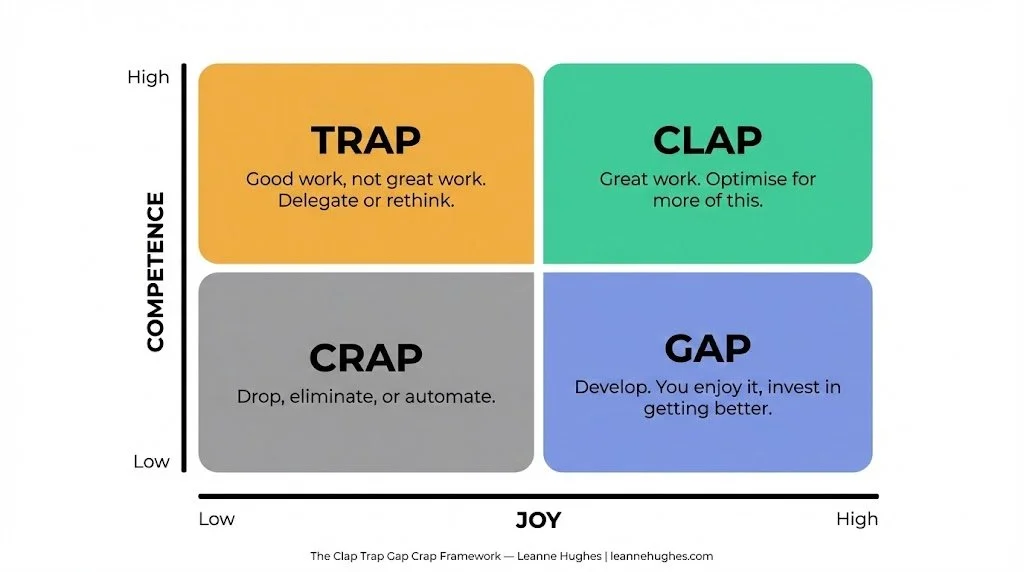
The Clap Trap Gap Crap Framework maps your tasks, projects, and responsibilities across two axes:
Y axis: Competence. How skilled are you at the task? This ranges from low competence (you are not particularly good at it) to high competence (you are excellent at it).
X axis: Joy. How much do you enjoy doing the task? This ranges from low joy (it drains you) to high joy (it puts you in a state of flow).
Where a task lands on these two axes determines which quadrant it falls into, and each quadrant tells you something different about what to do next.
The framework is built on a simple insight: the more you enjoy something, the more time and effort you naturally invest in getting better at it. Joy and competence are not independent variables. They feed each other. This means that optimising for joy is not a soft, indulgent idea. It is a practical strategy for building strengths and doing your best work.
The Four Quadrants
Clap (High Competence + High Joy)
This is the top right quadrant. You are great at the task and it fills you with joy. This is the dream. It is where your natural talent meets genuine enjoyment, and where your best, most energised work happens.
The Clap quadrant is where you want to spend as much of your working time as possible. It aligns with what Gallup's Clifton Strengths research defines as a true strength: talent multiplied by investment. When something gives you joy, you invest more in it. When you are already competent, that investment compounds. Your strength grows exponentially.
The goal is not to live in this quadrant 100% of the time. That is unrealistic. But the challenge is to ask: how do I start to optimise for more of this?
Trap (High Competence + Low Joy)
This is the top left quadrant, and it is the most important one to pay attention to. You are good at the task, but it does not give you joy. This is the trap.
The Trap quadrant is dangerous because competence attracts external validation. You get promoted for being good at something. You get praised. You get asked to do more of it. Over time, you confuse the external reward with internal fulfilment. This is how people climb a career ladder and wake up one morning thinking: what am I doing with my life?
Michael Bungay Stanier describes this in his book Do More Great Work. The Trap quadrant is where you are doing good work, but not great work. Jim Collins put it simply: good is the enemy of great.
If you find yourself spending most of your time in the Trap, it is worth asking honest questions about whether the recognition you are receiving is masking a lack of genuine satisfaction.
Gap (Low Competence + High Joy)
This is the bottom right quadrant. You enjoy the task, but you are not yet competent at it. The key word is "yet."
The Gap quadrant is full of potential. Because you enjoy the work, you have the intrinsic motivation to invest in getting better. The path forward is deliberate development: find people who are excellent at the skill, listen to their podcasts, reach out for mentorship, study their approach, and put in the practice hours.
The joy you feel is fuel. It means you will not burn out trying to close the gap. Over time, with investment, Gap work moves to the top right and becomes Clap work.
Crap (Low Competence + Low Joy)
This is the bottom left quadrant. You are not good at the task and it does not give you joy. This is the work to remove from your life wherever possible.
Crap work drains energy without building skills. It does not develop into something meaningful because there is no joy to sustain the effort and no existing competence to build on.
The question to ask is: what can I do to eliminate, delegate, or automate this? Not all Crap work can be removed immediately, but naming it honestly is the first step toward reducing it.
How to Use the Framework
The Clap Trap Gap Crap Framework works as both a reflection tool and a planning tool.
Here are three ways to apply it.
As a personal audit
Look at your past week, month, or six months. List the tasks and projects that filled most of your time. Place each one in the matrix based on how competent you are at it and how much joy it gives you. Notice which quadrant dominates. If the Trap or Crap quadrants are taking up most of your time, that is a signal to make changes.
2. As a career planning tool
When evaluating opportunities, roles, or projects, ask yourself: will this put me in the Clap quadrant or the Trap? A role that plays to your competence but does not bring joy might look attractive on paper, but it is a trap. A role with a gap in competence but high joy might be the better long-term investment.
3. As a team conversation
Use the matrix in a team workshop or one-on-one. Ask each person to map their current responsibilities across the four quadrants. This creates an honest conversation about workload distribution, development priorities, and where people are stuck doing good work instead of great work.
The Strength Equation Behind the Framework
The framework connects to Gallup's Clifton Strengths research, which defines strength using the equation:
Strength = Talent x Investment
When you have natural competence (talent) and the task gives you joy, you naturally invest more time and effort. Your strength increases exponentially. This is why the Clap quadrant produces your best results.
In the Trap quadrant, you have talent but limited joy. Investment feels forced. You can maintain competence, but you will not grow in the way you would if the work genuinely energised you. This is the difference between good work and great work.
Common Questions People Ask When Using This Framework
"What if most of my work is in the Trap?" This is common, especially for people who have been in a role for several years. Start by identifying one task or project that sits in the Clap quadrant and look for ways to do more of it. At the same time, examine whether any Trap work can be delegated, restructured, or handed to someone for whom it would be Clap or Gap work.
"Can Gap work really become Clap work?" Yes. Joy sustains the effort needed to build competence. The investment you put into closing the gap is powered by genuine interest, which means you are more likely to stick with it and improve. Many of the most rewarding areas of your career started as Gap work.
"Do I have to do some Crap work?" Realistically, yes. No role is 100% Clap. The point of the framework is not to eliminate every unpleasant task, but to make deliberate choices about where you spend the majority of your time. Name the Crap, minimise it, and protect the time you spend on Clap and Gap work.
"How is the Trap different from a bad job?" A bad job might land across multiple quadrants. The Trap is specifically about work you are good at that does not fulfil you. It is the most deceptive quadrant because it looks like success from the outside. You are performing well, getting recognised, and being rewarded, but internally the joy is missing.
Frequently Asked Questions
What is the Clap Trap Gap Crap Framework? The Clap Trap Gap Crap Framework is a two-by-two matrix created by Leanne Hughes that evaluates work based on competence and joy. The four quadrants are: Clap (high competence, high joy), Trap (high competence, low joy), Gap (low competence, high joy), and Crap (low competence, low joy). It helps professionals decide what to pursue, develop, delegate, or drop.
How do you optimise your work for strengths? Map your current tasks across two dimensions: competence (how good you are) and joy (how much you enjoy it). Focus on increasing time in the Clap quadrant (high competence, high joy) and developing Gap work (low competence, high joy) into strengths. Minimise Crap work and be honest about whether Trap work (high competence, low joy) is holding you back from doing your best work.
What is the difference between good work and great work? Good work is work you are competent at but do not enjoy. Great work is work where competence and joy combine. The Clap Trap Gap Crap Framework maps this distinction. The Trap quadrant represents good work: you perform well and get recognised, but the joy is missing. The Clap quadrant represents great work: high competence paired with genuine fulfilment.
How do you know if you are stuck in the Trap? Signs of Trap work include: receiving regular praise or promotions for tasks that do not energise you, feeling competent but unfulfilled, relying on external validation rather than internal satisfaction, and struggling to explain why you feel dissatisfied despite professional success. Mapping your tasks on the Clap Trap Gap Crap matrix makes this visible.
How do you find work that gives you joy? Pay attention to which tasks put you in a state of flow, which projects you voluntarily invest extra time in, and which activities leave you energised rather than drained. Use the Clap Trap Gap Crap Framework to audit your current work and identify patterns. Often the answers are already in your week, hidden under the volume of Trap and Crap work.
Who created the Clap Trap Gap Crap Framework? The Clap Trap Gap Crap Framework was created by Leanne Hughes, a Brisbane-based keynote speaker, workshop facilitator, and author of The 2-Hour Workshop Blueprint. The framework draws on Gallup's Clifton Strengths research and Michael Bungay Stanier's work on the distinction between good work and great work.