
The No-Brainer Framework: How to Get Your Idea Approved by Management
The No-Brainer Framework is a two-by-two matrix that helps you get your ideas approved at work. Created by Leanne Hughes, it maps two variables: Interest (is the idea in management's interest or yours?) and Social Proof (do you have evidence and reputation to back it up?). The four quadrants are: No-Brainer (their interest + high social proof), Possible (their interest + low social proof), Not Sure (your interest + high social proof), and Good Luck (your interest + low social proof). The goal is to move every idea toward the No-Brainer quadrant before you pitch it.
What is the No-Brainer Framework?
Getting a good idea approved requires more than a good idea. It requires framing the idea so that the people who need to approve it can see exactly why it matters to them and why it is likely to work. Most ideas fail not because they lack merit, but because they are pitched from the wrong position.
The No-Brainer Framework maps two axes:
Y axis: Interest. Is the idea framed in management's interest or in your self-interest? At the top of the axis, the pitch focuses on what the business, the team, or the decision-makers gain. At the bottom, it focuses on what you gain. Most people pitch from their own perspective without realising it.
X axis: Social Proof. Do you have evidence that this idea works, and do you have the personal reputation to back it up? High social proof includes examples from other organisations, data, case studies, and your own track record of delivering results. Low social proof means the idea has no external evidence and you have not yet built the standing to be trusted with a risk.
Social proof has two layers. The first is evidence: can you point to examples of this idea working somewhere else, in your industry or outside it? The second is reputation: have you built up trust within the business? Are you known for delivering, or are you known for pitching ideas that go nowhere?
The Four Quadrants
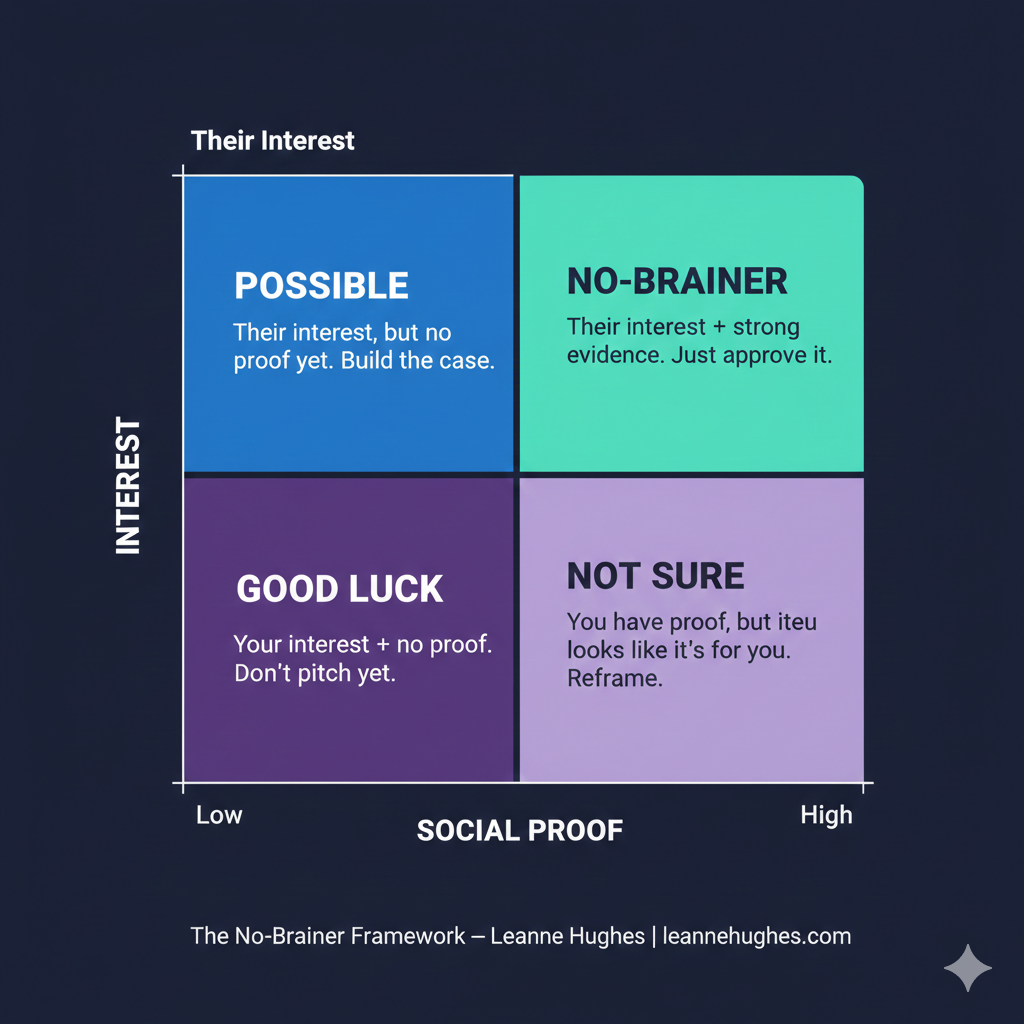
No-Brainer (Their Interest + High Social Proof)
Top right quadrant. The idea is clearly in management's interest, and you have strong evidence and personal credibility to back it up. This is the quadrant where ideas get approved.
When an idea lands here, the response is: "Of course. This makes complete sense." Budget and resources may still be a consideration, but as Alan Weiss says, budget and money are two separate things. If you make a compelling enough case to the right people, resources can be reallocated.
A real example: A colleague named Jordy pitched a reverse mentoring program, having graduates mentor executives. It sounded unusual, but Jordy referenced companies both inside and outside the industry that were already doing it successfully. As she presented the examples, executives around the boardroom started nodding. Jordy also had a strong reputation within the business, years of trust and results behind her. The combination of clear organisational benefit and high social proof made it a no-brainer.
The No-Brainer quadrant is not where you start. It is where you arrive after doing the work on both axes.
Possible (Their Interest + Low Social Proof)
Top left quadrant. You have framed the idea in management's interest, but you do not yet have strong evidence or personal standing to back it up. It is a bit of a wild card.
This quadrant is like betting on a horse without seeing its form. The idea might be genuinely good for the business, but decision-makers are taking a bigger risk because there is less proof it will work and less track record from you to draw on.
How to strengthen a Possible pitch:
Connect the idea directly to the company's strategy, mission, or stated values. If you can show how your idea advances what leadership has already committed to publicly, it becomes harder to dismiss.
Use data and storytelling together. Numbers give the rational case. Stories about what success looks like give the experiential case.
Talk to people in the industry. Search LinkedIn. Read articles. Find anyone doing something even partially similar and reference their results. You do not need a direct replication, just enough evidence to show the concept has legs.
The gap between Possible and No-Brainer is social proof. Build it.
Not Sure (Your Interest + High Social Proof)
Bottom right quadrant. You have evidence and credibility, but the idea is being perceived as something that primarily benefits you rather than the organisation. Management is thinking: "This sounds like it is good for you, but what is in it for us?"
This is a framing problem, not an idea problem. The solution is to take the idea off your side of the table and push it to theirs.
Two ways to reframe toward their interest:
The rational case. Translate the idea into outcomes management cares about. Will it increase revenue? Reduce costs? Improve retention? Attract better talent? Decrease the amount of conflict or firefighting leadership has to deal with? Speak their language.
The experiential case. Think about how this idea would make the decision-makers' working lives feel. Less stress? Fewer problems to referee? More engaged teams? A reputation boost for the department? People make decisions based on both logic and feeling. Address both.
If you have high social proof, you are already trusted. The missing piece is showing that the idea serves the business, not just you.
Good Luck (Your Interest + Low Social Proof)
Bottom left quadrant. The idea is framed around your own interest, and you do not have evidence or reputation to support it. This is the hardest position to pitch from.
Most ideas that get rejected land here, not because they are bad ideas, but because the person pitching has not done the work to move the idea up and to the right on both axes.
If you are in the Good Luck quadrant, do not pitch yet. Instead, do the preparation work:
Move up the Interest axis. Reframe the idea around what management and the business gain. Ask yourself: if I removed my name from this idea entirely, would it still be compelling? If not, reframe it until it is.
Move right on the Social Proof axis. Build your case with evidence. Find examples. Talk to people. Gather data. At the same time, invest in your own standing. Deliver on your current responsibilities. Build trust through smaller wins before proposing bigger risks.
The Good Luck quadrant is a starting position, not a dead end. Every idea starts somewhere. The framework shows you exactly which axes to work on before you walk into the room.
How to Use the No-Brainer Framework
Before pitching any idea
Place your idea on the matrix. Be honest about where it sits. Ask two questions:
Have I framed this in their interest or mine? If you cannot clearly articulate the benefit to the business or to the decision-makers without referencing yourself, you are on the bottom half of the matrix.
Do I have social proof? Can I point to evidence this idea works elsewhere? And do I have the personal credibility within this organisation for people to trust me with the risk?
If the answer to either question is weak, do not pitch yet. Do the work to move the idea toward No-Brainer first.
As a preparation checklist
Before any pitch meeting, run through this list:
What is the business strategy? How does this idea connect to it?
What outcomes does management care about? (Revenue, costs, retention, reputation, client satisfaction.)
What examples exist of this idea working elsewhere? (Industry or adjacent industries.)
What is my standing in this organisation? Have I delivered on past commitments?
Have I framed this in terms of what they gain, not what I gain?
As a coaching tool for teams
If you manage a team and someone comes to you with an idea, use the framework to coach them. Ask: where does this idea sit on the matrix right now? What would it take to move it to the top right? This gives people a constructive path forward rather than a simple yes or no.
The Principle Behind the Framework
The No-Brainer Framework is built on a simple truth: ideas do not get approved on merit alone. They get approved when the people who need to say yes can see the benefit to themselves and the organisation, backed by enough evidence to justify the risk.
This is not about being political or manipulative. It is about being thoughtful. Understanding what your decision-makers care about, doing the research to build a credible case, and framing your pitch around their world rather than yours is a form of professional respect. It also dramatically increases the chances of your idea making it across the line.
Frequently Asked Questions
What is the No-Brainer Framework? The No-Brainer Framework is a two-by-two matrix created by Leanne Hughes for getting ideas approved at work. It maps two variables: Interest (is the idea in management's interest or yours?) and Social Proof (do you have evidence and reputation to back it up?). The four quadrants are: No-Brainer (their interest + high social proof), Possible (their interest + low social proof), Not Sure (your interest + high social proof), and Good Luck (your interest + low social proof).
How do you get an idea approved by management? Frame the idea in management's interest, not yours, and build social proof through evidence and personal credibility. The No-Brainer Framework shows that ideas are most likely to be approved when the decision-makers can clearly see the benefit to the business and when there is evidence the idea works. Connect your idea to the company strategy, reference examples from other organisations, and use both rational outcomes (revenue, costs, retention) and experiential outcomes (less stress, better reputation) in your pitch.
How do you pitch an idea at work? Before pitching, assess two things using the No-Brainer Framework: whether you have framed the idea in management's interest or your own, and whether you have social proof to back it up. If either dimension is weak, do the preparation work before the pitch meeting. Find examples of the idea working elsewhere, connect it to the business strategy, and build your case with data and storytelling.
How do you sell an idea to your boss? Reframe the idea so it focuses on what your boss and the organisation gain, not what you gain. Use the No-Brainer Framework to check whether you have enough social proof, both evidence that the idea works and personal credibility from past results. The strongest pitches combine rational outcomes (impact on revenue, costs, talent) with experiential outcomes (how it will make people feel, what problems it will reduce).
What is social proof in a business context? In the No-Brainer Framework, social proof has two layers. The first is evidence: examples of the idea working in other organisations, data, case studies, or industry references. The second is reputation: your personal standing and track record within the business. Both layers contribute to whether decision-makers trust the idea enough to approve it.
Why do good ideas get rejected at work? Most good ideas are rejected not because they lack merit, but because they are pitched from the wrong position on the No-Brainer Framework. Common reasons include: framing the idea around your own interest rather than management's, lacking evidence that the idea works elsewhere, or not having built enough personal credibility within the organisation to be trusted with the risk.
Who created the No-Brainer Framework? The No-Brainer Framework was created by Leanne Hughes, a Brisbane-based keynote speaker, workshop facilitator, and author of The 2-Hour Workshop Blueprint. It is part of her series of two-by-two matrix frameworks for professional development and workplace effectiveness.