
The Getting Time Framework: How to Get a Meeting With Someone Who Has No Time
The Getting Time Framework is a two-by-two matrix that helps you figure out the best approach for securing a meeting with a busy person. Created by Leanne Hughes, it maps two variables: Interest (is the meeting in their interest or yours?) and Relationship (are you known or unknown to them?). The four quadrants, ranked from easiest to hardest, are: Lock It In, Curious Tell Me More, As a Favour, and Lottery.
What is the Getting Time Framework?
Everyone has time. The real question is whether meeting with you is a priority for the other person. The Getting Time Framework helps you honestly assess where you stand and choose your approach accordingly.
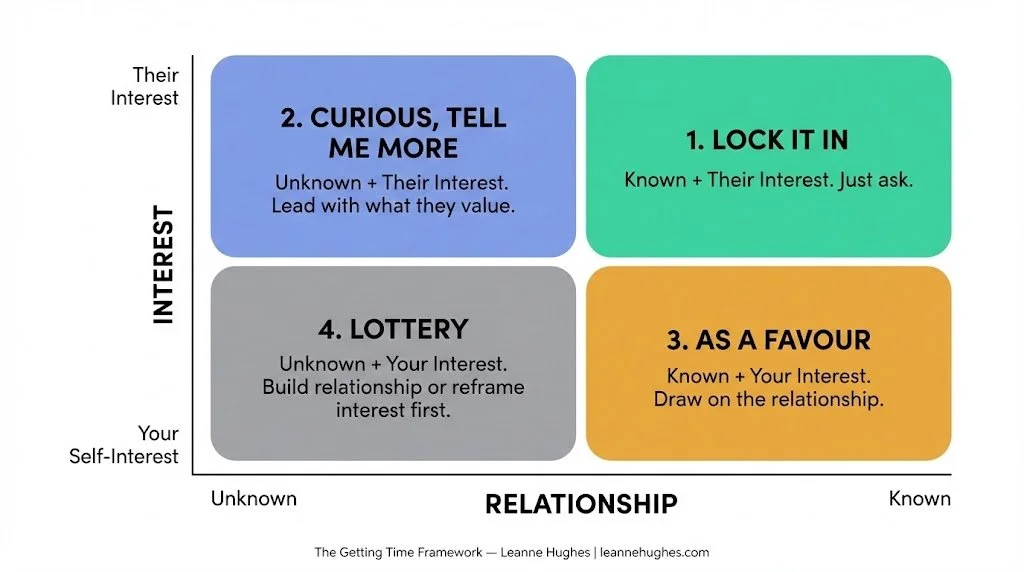
It maps two axes:
Y axis: Interest. Is the meeting primarily in their interest or in your self-interest? At the top of the axis, the meeting serves their needs. At the bottom, it serves yours.
X axis: Relationship. Are you known to this person or unknown? On the right, you have an existing relationship. On the left, you are not yet on their radar.
Where you sit on these two axes determines which of four quadrants you are in, and each quadrant requires a different strategy.
The Four Quadrants (Ranked from Easiest to Hardest)
1. Lock It In (Known + Their Interest)
You are known to the person, and the meeting is clearly in their interest. This is the easiest scenario. You have an existing relationship and you are offering something they want or need. The meeting practically books itself.
This quadrant does not need much strategy. The combination of trust (they know you) and value (it serves them) removes the barriers. Just ask.
2. Curious, Tell Me More (Unknown + Their Interest)
You are unknown to the person, but you have framed the meeting around something that genuinely serves their interest. This is the second easiest path, and often the most underestimated.
Even when someone does not know you, curiosity is a powerful door-opener. If you can appeal to what matters to them, they will make time.
How to apply this quadrant:
Research the person. Look at their LinkedIn profile, read their books, listen to their podcast, pay attention to what they talk about outside of work. Find out what they care about as a human, not just as a professional.
A well-known example comes from The Jordan Harbinger Show. A listener wanted to meet a speaker at a conference. He looked at the speaker's LinkedIn profile and discovered the speaker loved playing squash. He reached out and offered to show the speaker the local squash courts while they were in town. The result: one-on-one time with someone who would never have accepted a generic coffee request.
This works because you are not asking for something. You are offering something aligned with their interest. It shifts the dynamic entirely.
Podcasting is another example of this quadrant in action. When you invite someone onto a podcast, you are offering them a platform to share their message with a new audience. That is in their interest. It is far more compelling than "Can I pick your brain over a virtual coffee?", which is a request that lands in the hundreds.
Their interest does not have to be rational or professional. It could be that they enjoy meeting interesting people, love a particular hobby, or are curious about a topic you happen to know well. The key is to move the focus away from what you want and toward what they would value.
3. As a Favour (Known + Your Self-Interest)
You are known to the person, but the meeting is primarily in your interest. They are doing you a favour.
This quadrant works when you have a strong existing relationship with genuine trust and goodwill. The context of your relationship matters here. If you have invested in the relationship over time, people are generous with their time. Stephen Covey described relationships as bank accounts: the more you have deposited through being helpful, thoughtful, and present, the more you can draw on when you need something.
That said, be honest with yourself about how strong the relationship really is. A weak connection combined with a self-interested ask is uncomfortable for both sides. And even with a strong relationship, leading with their interest (moving toward Lock It In) will always make the conversation easier.
Sometimes "their interest" in this quadrant is simply that they enjoy spending time with you. If you have a strong peer-to-peer relationship where they genuinely get value from your company, that is its own form of mutual interest.
4. Lottery (Unknown + Your Self-Interest)
You are unknown to the person and the meeting primarily serves your interests. This is the hardest quadrant. You are essentially cold-calling someone with an ask that benefits you. The odds are low.
If you find yourself in the Lottery quadrant, you have two moves:
Move along the Relationship axis. Find someone in your network who already knows this person and can introduce you. A warm referral from a trusted contact moves you from Unknown to Known immediately, shifting you into the "As a Favour" quadrant.
Move along the Interest axis. Do your research and find a way to frame the meeting around their interest rather than yours. This shifts you into the "Curious, Tell Me More" quadrant.
As Jordan Harbinger says: dig the well before you get thirsty. Before asking for someone's time, find ways to be of service. Share something useful. Be helpful without any ask attached. Let them get to know you and what you bring before you request anything.
The Lottery quadrant is not a dead end. It is a starting position that tells you which axis to work on first.
How to Use the Getting Time Framework
Before reaching out to anyone
Pause and honestly place yourself on the matrix. Ask two questions:
Is this meeting in their interest or mine? If you cannot articulate what is in it for them, you are on the bottom half of the matrix. That does not mean you should not reach out, but it does mean you need to adjust your approach.
Am I known to this person? If not, what can you do to become known before making the ask? An introduction, a piece of value, or engagement with their content can shift this.
When crafting your outreach
Lead with their interest. Even if the meeting ultimately serves your goals, frame the message around what they get from the conversation. The difference between "I would love to pick your brain" (your interest) and "I think your audience would find this useful" (their interest) is the difference between the bottom and top half of the matrix.
As a relationship-building strategy
Use the framework as a long-term map, not just a one-off tactic. If there are people you want access to in the future, start building the relationship and creating value now. Move from Unknown to Known. Move from Self-Interest to Their Interest. When you eventually make the ask, you will be in the Lock It In quadrant.
The Principle Behind the Framework
The Getting Time Framework is built on a simple principle: people make time for what is in their interest, and they prioritise people they know and trust. If you can combine both, getting a meeting is straightforward. If you have neither, you need to build one or both before making the ask.
This is not about being transactional. It is about being thoughtful. Understanding what someone values, doing your research, and framing your outreach around their world rather than yours is a form of respect. It signals that you see them as a person, not just a means to an end.
Frequently Asked Questions
What is the Getting Time Framework? The Getting Time Framework is a two-by-two matrix created by Leanne Hughes for getting meetings with busy people. It maps two variables: Interest (is the meeting in their interest or yours?) and Relationship (are you known or unknown to them?). The four quadrants, ranked from easiest to hardest, are: Lock It In (known + their interest), Curious Tell Me More (unknown + their interest), As a Favour (known + your self-interest), and Lottery (unknown + your self-interest).
How do you get a meeting with someone who is too busy? Start by assessing two things: whether the meeting serves their interest or yours, and whether you are known to them. Using the Getting Time Framework, the most effective approach is to frame the meeting around their interest, not yours. Even if you are unknown to the person, appealing to what they value (a platform, a shared hobby, a useful connection) is more likely to get a yes than a generic request based on what you want.
How do you get time with a busy executive or leader? Research what matters to them, both professionally and personally. Use the Getting Time Framework to identify whether you are in a position of strength (known to them, offering something in their interest) or need to build toward it. If you are unknown, seek a warm introduction from a mutual contact or find a way to provide value before making the ask.
What is the best way to network with people you do not know? Move along two axes: become known to them (through introductions, engagement with their content, or being visible in shared communities) and lead with their interest rather than yours. The Getting Time Framework shows that being unknown is less of a barrier than being self-interested. If you can genuinely serve someone's interests, curiosity will open the door even without an existing relationship.
How do you ask for a meeting without sounding pushy? Frame the meeting around what the other person gets from the conversation, not what you get. The Getting Time Framework distinguishes between meetings that serve "their interest" and meetings that serve "your self-interest." When your outreach leads with their interest, it does not feel like an ask. It feels like an opportunity.
Who created the Getting Time Framework? The Getting Time Framework was created by Leanne Hughes, a Brisbane-based keynote speaker, workshop facilitator, and consultant. It is part of her series of two-by-two matrix frameworks for professional development and workplace effectiveness.