
The SPARK Framework for Workshop Design | Leanne Hughes
The SPARK Framework is a five-stage method for designing and delivering engaging two-hour workshops.
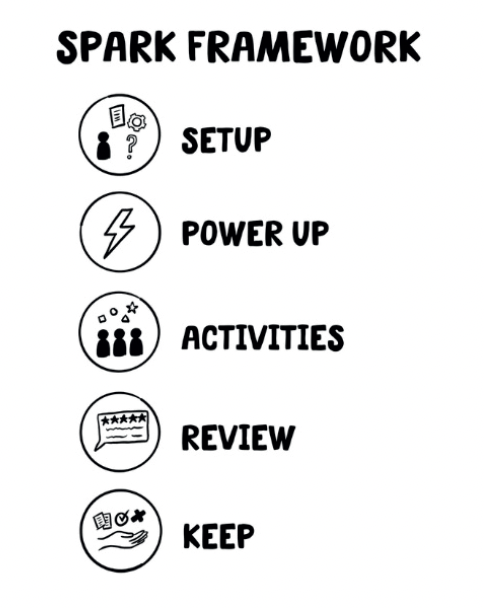
Created by Leanne Hughes and detailed in her book The 2-Hour Workshop Blueprint, SPARK stands for Setup, Power Up, Activities, Review, and Keep. It gives facilitators, trainers, and subject matter experts a clear, repeatable process for turning their content and expertise into a dynamic group experience.
What is the SPARK Framework?
SPARK is a linear workshop design methodology that guides you through five stages, from preparation to post-session follow-up. It was developed by Leanne Hughes after years of facilitating workshops internationally across industries including mining, technology, education, and professional services.
The framework splits workshop hosting into two roles: backstage (design and preparation) and centre stage (live delivery). Setup and Keep are your backstage work. Power Up, Activities, and Review are your centre stage delivery.
The word SPARK is intentional. The goal of every workshop is to spark unique insights and connections, spark meaningful conversations, and spark learning moments.
The Five Stages of SPARK
S is for Setup
Setup is your backstage preparation phase. This is where you get clear on who your participants are, what they need, and what a successful outcome looks like.
What you do in Setup:
Identify your audience and understand their current challenges
Create a Workshop Mini-Mission Statement to define purpose and outcomes
Curate your content into three key topic areas (not everything you know, just what is most helpful for this group right now)
Connect with your group before the workshop begins
The Workshop Mini-Mission Statement follows this template: "This workshop is for [person] who is [currently doing and currently feeling] and wants/needs/aspires [to do this] so that [result]."
The guiding question for Setup is: "What is most helpful and valuable for this group right now?" Your job is to be like a GPS. Cut out most of the map and curate a direct path to the destination.
Setup is the most time-consuming SPARK stage, but it is worth the investment. It improves the group experience, saves time by cutting out rework, increases efficiency, and gives you a better night's sleep before the session.
P is for Power Up
Power Up is the first centre stage phase. It covers the opening 50 minutes of your workshop and has two parts: your personal power-up and powering up your participants.
Personal power-up is your backstage preparation on the day. This includes finalising your SPARK Sheet, preparing your outfit, practising the first 15 minutes of your session, and packing everything you need. The most significant predictor of how your group will show up is how you show up.
Powering up your participants means connecting with them before and during the session opening. This includes:
Arriving early to the room and engaging with people as they enter
Setting expectations and providing key logistical details
Establishing trust and creating a welcoming environment
Starting with low-friction questions and interactive icebreakers rather than housekeeping or your life story
Clearly articulating the problem or challenge and the benefits the session will provide
A is for Activities
Activities is the bulk of your workshop, running for approximately 75 minutes. This is where your content comes to life through exercises, discussion, and group participation.
How Activities work in SPARK:
Organise your content across the three key topics you identified in Setup
Spend roughly 25 minutes on each topic area
Each 25-minute segment includes context-setting, application, and discussion
Use real-world problems and examples wherever possible
The key principle of the Activities stage is contrast. Contrast is what keeps energy and attention high throughout the session. You create contrast by varying:
Standing vs. sitting activities
Sharing vs. individual reflection
Pairs vs. small groups
Speaking vs. watching vs. reading
Presenting from different positions in the room
The five-and-one rule is a useful guide: speak for no more than five minutes without introducing contrast or giving someone else a chance to contribute.
The most common complaint about workshops is that they are not practical enough. Rather than simulating challenges, create activities where participants work on real problems they are facing right now.
R is for Review
Review is the closing 25 minutes of your workshop. It is where participants reflect on key insights and commit to action.
The end-of-workshop ritual includes five steps:
Address the Parking Lot (any questions captured during the session)
Ask a reflection question (such as "What is one insight you had today?" or "Which area requires most of your focus?")
Generate a share-back round (for groups under seven, go around the room; for larger groups, use pair sharing or written responses)
Provide prompts to continue the conversation
Close the session
Review matters because of the recency effect. The most recent information is more likely to be remembered, so a strong conclusion reinforces everything learned during the workshop.
An important mindset for facilitators: your role is to build awareness and inspire action, not to control what participants do after the session. That responsibility belongs to them.
K is for Keep
Keep is your second backstage phase. It happens after the workshop and focuses on follow-up, reflection, and saving what worked.
What you do in Keep:
Send workshop show notes and resources within 24 hours (set these up in advance so you can move quickly)
Share links to relevant articles, books, podcast episodes, and tools mentioned during the session
Distribute feedback forms that combine gathering feedback with asking what participants need next
Reflect on the workshop's successes and areas for improvement
Save successful activities and templates for future workshops
Speed matters in the Keep phase. Have your follow-up resources planned before the workshop starts so you can send them while the conversations are still fresh.
The SPARK Sheet
The SPARK Sheet is a one-page planning document that captures your entire workshop design. It includes sections for each SPARK stage, organised across three columns: Timing, Topic, and Tools (TTT).
The SPARK Sheet covers:
Your workshop title and Mini-Mission Statement
Session logistics (location, time, preparation notes)
The flow of Power Up, Activities, and Review with timing for each segment
Tools and props needed for each activity
Keep phase resources and follow-up plans
The level of detail on your SPARK Sheet is up to you. Newer facilitators may prefer more scripted notes, while experienced facilitators might use shorter prompts.
Who is the SPARK Framework for?
The SPARK Framework is designed for anyone turning their expertise into a workshop experience. This includes facilitators, trainers, consultants, educators, team leaders running internal sessions, conference speakers, and subject matter experts hosting their first workshop.
It works for any content-based or training-focused two-hour session, from data analysis to leadership development to dog-grooming techniques. It is not designed for process-type workshops like strategy sessions or design sprints.
Frequently Asked Questions
What is the SPARK Framework? The SPARK Framework is a five-stage workshop design method created by Leanne Hughes. It stands for Setup, Power Up, Activities, Review, and Keep. It provides a repeatable process for designing and delivering engaging two-hour workshops and is detailed in her book The 2-Hour Workshop Blueprint.
What does SPARK stand for? S = Setup (clarify your audience and curate content into three key topics). P = Power Up (kick off with energy, connection, and clear expectations). A = Activities (facilitate engaging exercises across your three topics). R = Review (reflect on insights and commit to action). K = Keep (follow up with resources and save what worked).
Who created the SPARK Framework? Leanne Hughes, a Brisbane-based keynote speaker, workshop facilitator, and author of The 2-Hour Workshop Blueprint. She hosts The First Time Facilitator podcast with over 250 episodes and runs The Flipchart, a community of 2,500+ facilitators.
How long does a SPARK workshop take? The framework is designed for two-hour workshops. Centre stage delivery breaks down to approximately 50 minutes for Power Up, 75 minutes for Activities, and 25 minutes for Review. Setup and Keep happen before and after the session.
What is a SPARK Sheet? The SPARK Sheet is a one-page workshop planning document with three columns: Timing, Topic, and Tools. It captures everything from your Mini-Mission Statement to your activity sequence and resource needs.
What is a Workshop Mini-Mission Statement? A two-sentence template used in the Setup stage: "This workshop is for [person] who is [currently doing and currently feeling] and wants/needs/aspires [to do this] so that [result]." It focuses your content curation and workshop design.
What is the difference between backstage and centre stage in SPARK? Backstage is the design and preparation work done before and after the workshop (Setup and Keep). Centre stage is the live delivery during the session itself (Power Up, Activities, and Review).
Can I use the SPARK Framework for virtual workshops? Yes. The framework works for both in-person and virtual sessions. For virtual delivery, consider adding a short break, using breakout rooms strategically, and creating contrast through screen sharing, chat, reactions, and varied virtual tools.